2018年佛山中考英語(yǔ)模擬試題【word版含答案】
由于版式的問(wèn)題,試題可能會(huì)出現(xiàn)亂碼的現(xiàn)象,為了方便您的閱讀請(qǐng)點(diǎn)擊全屏查看
一、聽(tīng)力(共三節(jié),滿分為20分)
第一節(jié) 聽(tīng)句子,選擇最佳答語(yǔ)(共5小題;每小題1分,滿分5分)
每句播放兩遍。各句播放前每小題有4秒鐘的閱題時(shí)間。請(qǐng)根據(jù)各句播放內(nèi)容及其相關(guān)小題, 在4秒鐘內(nèi)從各題所給A、B、C項(xiàng)中, 選出最佳選項(xiàng), 并把答案涂在答題卡上。
( )1. A. I’m sorry.B. You are welcome.? C. The same to you.
( )2. A. I love it a lot.B. With pleasure.? C. No, thanks.?
( )3. A. Yes, please.? B. It’s great.C. I don’t feel well.
( )4. A. Thank you.? B. Not beautiful.? C. You are great.
( )5. A. Sure. B. Here you are.? C. Good luck.
第二節(jié) 聽(tīng)力理解(共10小題;每小題1分,滿分10分)
每段播放兩遍。各段播放前每小題有4秒鐘的閱題時(shí)間。請(qǐng)根據(jù)各段內(nèi)容及其相關(guān)小題, 在4秒鐘內(nèi)從各題所給的A、B、C項(xiàng)中, 選出最佳選項(xiàng), 并把答案涂在答題卡上。
聽(tīng)下面一段對(duì)話,回答第6--7兩個(gè)小題。
( )6. Where does the woman want to go?
????????????? A. A park.? ????????????? B. A bank.C. A hotel.
( )7. How will the woman go there?
On foot. B. By bus.? C. By bike.
聽(tīng)下面一段對(duì)話,回答第8—9兩個(gè)小題。
( )8. Where is Kate going for her summer vacation?
Beijing. ????????????? ? B. Taiwan.? C. Sichuan.
( )9. How long will they stay there?
????????????? A. Two weeks.B. Two months.? C. Two days.
聽(tīng)下面一段獨(dú)白, 回答第10—12三個(gè)小題。
( )10. What does Ann think of being a doctor ?
????????????? A. Easy.? ????????????? B. Difficult.C.Interesting.?
( )11. What does Ann want to be?
????????????? A. A nurse.B. A doctor.C. A reporter.
( )12. Which of the following is TRUE?
????????????? A. Bob’s father is a western medicine doctor.
????????????? B. Li Shizhen is Ann’s favourite famous person.
C. Bob must learn a lot about herbs(草本植物) if he wants to be a Chinese medicine doctor.?
聽(tīng)下面一段對(duì)話, 回答第13—15三個(gè)小題。
( )13. Why hasn’t Amy done her math homework yet?
????????????? A. Because she wants to do it with Tom.
? B. Because it’s too difficult for her.
C. Because she wants to watch TV first.
( )14. Tom is not good at English, is he?
????????????? A. Yes, he is.? B. No, he isn’t.C. Yes, he isn’t.?
( )15. When are they going to meet in order to do homework?
????????????? A. At 5:30? B. At 6:30C. At 5:00?
第三節(jié) 聽(tīng)取信息 (共5小題; 每小題1分, 滿分5分)
聽(tīng)下面一段獨(dú)白, 請(qǐng)根據(jù)題目要求, 從所聽(tīng)到的內(nèi)容中獲取必要的信息, 填入答題卡標(biāo)號(hào)為16-20的空格中。聽(tīng)錄音前,你將有10秒鐘的閱題時(shí)間,錄音讀兩遍。你將有40秒鐘的作答時(shí)間。
What is U2? | It is a 16_______ band. |
When was the band set up? | In 17_______________. |
How many members are there in the band? | There are 18__________. |
What did the band do? | They travelled a lot and gave 19_____ in many countries. |
How did the band become in the 1980s? | It became 20________ in the 1980s. |
二、語(yǔ)言知識(shí)及應(yīng)用(共兩節(jié),滿分25分)
第一節(jié) 單項(xiàng)選擇(共15小題;每小題l分,滿分l5分)
? 閱讀下列各題,從各題所給的A、B、C項(xiàng)中選出最佳選項(xiàng),并在答題卡上將該項(xiàng)涂黑。
( )21. —Would you like _____ to drink?— Yes, I’d like a cup of coffee.
A. something elseB. anything else C. other something
( )22. There are so many kinds of MP5 in the shop. We can’t decide _____.?
A. what to buyB. how to buyC. which to buy
( )23.— I left my keys in the room yesterday. I had to get in _____ the window
? — It’s dangerous to do that.
A. in? B.throughC. over
( )24.— I heard you and Tom were going to Hainan for your holiday.
? — Really? _____.
It’s a pleasure. B. That’s OK.C. That’s news to me.
( )25. Don’t be afraid of maths. You should _____ the difficulty with courage.
faceB. meetC. rise
( )26.—Chinese astronauts can also walk in space now.
—Yes, they’re _____ our nation.
A. proud ofB. pleased withC. the pride of
( )27.—How long is the bridge?
—It’s _________.
A. 300 meters long B. 300-meters- long C.300-meter- long
( )28. They picked as______ apples as they liked on the farm.?
A. muchB. many C. more
( )29. Cathy was very glad to meet ____ old friend on the train to London.
aB. an? C. the
( )30.—How long may I _____ your dictionary?
? —For one week. But it mustn’t _____ to others.
A. keep, be lent B. borrow, be lent C. have, lend
( )31. He __________ the homeless since then.?
A. has helpedB. helped? C. helps?
( )32. — role she played in the movie! That’s why she has a lot of fans.
A. How interesting? B. What interesting? C. What an interesting
( )33. I remember ___ my homework yesterday because it isn’t in my desk now.
A. handing toB. handing inC. to hand in
( )34. —Tom wants to know if _____ a picnic next Sunday.
—Yes, but if it _____, we’ll visit the museum instead.
you have, will rain? B. you will have, rains? C. you will have, will rain
( )35. Each of us _____ such a bank which is called TIME.
A. has B. have C.is having
第二節(jié)2018年佛山中考英語(yǔ)模擬試題完形填空(共10小題;每小題1分,滿分10分)
????????????? 閱讀下面短文,掌握其大意,然后從各題所給的A、B、C項(xiàng)中,選出最佳選項(xiàng),并在答題卡上將該涂黑。
On Mother's Day, after my children arrived home from school, the doorbell 36? .I went to answer it, and there stood two clean-faced, tall, smiling37? . They held two of the most beautiful flowers I had ever seen. They said to me, “Do you38us? You often fed us cookies! They were so39? . We wanted to come back and thank you and say Happy Mother's Day because you were like a mom to us!" I couldn't help crying, and thanked them.
I remembered the old days. At that time I did not have a lot of money or a big house and I was a single mom with three young40of my own.
The two boys were a bit older41my children. They always visited my yard, but they42cared about the fact that their faces were dirty. Every day they enjoyed themselves with my43girls and one small boy.
I spent a lot of time44healthy cookies. The two boys played happily in my yard, and they were quite happy to share(分享) food, books, games and then, for a time, they didn't visit us. I wanted to know what happened in their lives, and hoped for the best.
But now they came back and thanked me. This is the45gift I have ever received from two young boys.
( )36. A. received B. sang C. rang
( )37. A. boys B. students C. characters
( )38. A. ask? B. forgetC. remember
( )39. A. delicious B. natural? C. simple
( )40. A. children B. sons C. daughters
( )41. A. on? B. than? C. over
( )42. A. neverB. quite C. always
( )43. A. threeB. two? C. four
( )44. A. eating? B. playing? C. baking
( )45. A. goodB. better C. best
三.閱讀(共15小題,每小題2分,滿分30分)
第一節(jié) 閱讀理解
閱讀下列短文,從各題所給的A、B、C、D項(xiàng)中,選出最佳選項(xiàng),并在答題卡上將該項(xiàng)涂黑。
A
Whenever the sun dropped and the blue sky came up, my father and I used to climb the mountain near my house. Walking together, my father and I used to have a lot of conversations through which I learned lessons from his experiences. He always told me, “You should have goals like climbing the mountain.” Without the mountain-climbing that we both enjoyed, we couldn’t have enough time to spend together because my father was very busy. I really got a lot from mountain-climbing. It gave me time to talk with my father and to be in deep thought as well as develop my patience (耐力).
Once we climbed a very high mountain. It was so challenging for me because I was only ten years old. During the first few hours of climbing, I enjoyed the flowers and trees, and the birds’ singing, but as time passed, I got a pain in both of my legs. I wanted to quit climbing. In fact, I hated it at that moment, but my father said to me, “You can always see a beautiful sky at the top of the mountain, but you can’t see it before you reach the top. Only there at the top, can you see all of the nice things, just like in life.”
At that time, I was too young to understand his words. But later after that, I got new hope and confidence. I found myself standing at the top of the sky, which was as clear as crystal (水晶).
( )46. The passage tells us that mountain-climbing was ____ for Father and Son.
A. hard????????????? ????????????? ? B. enjoyable? ????????????? C. painful????????????? ????????????? ? D. comfortable
( )47. The underlined word “quit” in the passage means “________”.
A. carry on ????????????? ????????????? B. put off? ????????????? C. give up????????????? ????????????? ? D. pick up
( )48. Which of the following is similar in meaning to the father’s words in the second paragraph?
A. You will get all you need at the top of the mountain.????????????? ?????????????
B. The sky is always as clear as crystal. ????????????? ?????????????
C. You can find life is full of nice things.
D. Never give up half-way.
( )49. We can infer (推斷) from the last paragraph that ________.
A. the writer was very successful in his life ?????????????
B. the writer didn’t reach the top of the mountain
C. though the writer was young, he could understand his father? ?????????????
D. the writer used to stop half-way when he climbed the mountain
( )50. The best title for the passage is“________”.
A. Reaching the Top of the Mountain????????????? B. Enjoy the Beautiful Views
C. Conversations between Father and Son????????????? D. Father and I
B
There is not enough oil in the world now. As time goes by, it becomes less and less, so what are we going to do when it runs out? Perhaps we will go back to using horses, carriages and bicycles.
In the Second World War, some people didn’t use gas made from petroleum (石油) in their cars. They made gas from wood and plants instead. The car didn’t go fast, but they ran, so this was better than nothing. However, in the future, we can’t cut down all our trees to make gas; we need our trees for other things, too.
Besides different types of gas, we can also use electricity to run our cars, but first we must make the electricity! Some countries have coal and they make electricity with that, but we might not always have coal, either. Other countries have big, strong rivers, and they can use the power of water to turn turbines (渦輪機(jī)) and make electricity more easily and cheaply.
We are also able to get power from the ocean tides(潮汐). We put turbines into the mouth of the river. Then the tide comes in, the water turns the turbines and then it goes out, it turns them again.
Which of these ways will be used to run our cars in the future?
?????????????
( )51. When might people have to go back to using horses and carriages?
A. When they are poor.
B. When they run out of oil.
C. When they need more exercise.????????????? ?????????????
D. When there aren’t any big trees in the world.
( )52. What did some people use to make gas in the Second World War?
A. Water????????????? ????????????? B. Coal????????????? C. Wood and plants????????????? ????????????? D. Tides
( )53. How many ways are suggested to make electricity in the passage?
A. 2 ????????????? B. 5 C. 4 ????????????? D. 3
( )54. According to the passage, which of the following statements is TRUE?
A. There is more petroleum than we can use now.
B. Trees are needed for some other things besides making gas.
C. We got electricity from ocean tides in the old days.
D. Gas wasn’t used to run cars in the Second World War.
( )55. The passage is mainly about ________.?
A. how to run our cars????????????? B. what to do when oil runs out?????????????
C. different types of gas????????????? D. the ways to make electricity
主題匹配 (共5小題;每小題2分,滿分10分)
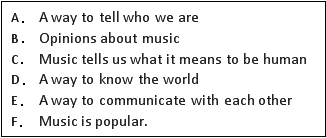
閱讀下面5段語(yǔ)言材料,從 A 到 F 選項(xiàng)中找出與它們相對(duì)應(yīng)的標(biāo)題,在答題卡上將該項(xiàng)涂黑。
( )56. How important is music? When they are asked this question, students and parents usually answer that music is nice, but not very important. It is often considered only as fun, but not the first choice for education. This opinion is shortsighted(短視的). In fact, music education is necessary and important for all students.
( )57. Music tells us who we are. Music shows people’s thinking and values, as well as the social environment it came from, just as Mozart music is a lifestyle, rock music is also a lifestyle.
( )58. Music provides a kind of ability to know the world in a different way. Science explains how the sun rises and sets. Music studies the emotive(情感的) meanings. We need every possible way to discover and respond(回應(yīng)) to our world because no one way can get it all.
( )59. Music is a form of thought, as powerful as science. It is a way we human beings “talk” to each other. Through the language we express our feelings, our discoveries, our ideas and our hopes so that they can be shared with others.?
( )60. When we do not let our children receive good music education, we take away from the meanings that music expresses. Science does not tell us what it means to be human. Music does.?
四、綜合語(yǔ)言運(yùn)用(共三節(jié),滿分45分)
第一節(jié)? 綜合填空(共10小題;每小題l分,滿分l0分)
閱讀下面短文,掌握其大意,然后根據(jù)短文內(nèi)容和首字母提示,在短文空白處填入適當(dāng)?shù)膯卧~,使短文內(nèi)容通順、合理。并將完整的單詞填寫(xiě)在答卷的相應(yīng)位置上。
You can buy chewing gum(口香糖) in nearly every country of the (61)w______. But it wasn’t always like that in the past.
The American Indians were the (62)f_____ people to chew gum. This gum came from a special tree that grew on their land. In 1848, a sailor (63)c_____ John Curtis began selling it. He was the first person to (64)s_____ chewing gum. The gum he sold cost just a few cents for two pieces. It became popular very quickly even though it was very hard to chew. Nowadays, other things are added to the gum to make it soft and sweet.
By 1890, there were (65)h_______ of different chewing gums. The most famous name in chewing gum, (66)h________, is probably William Wrigley. He spent a lot of money in advertising and even sent free pieces of gum to children on their birthdays. He also said that chewing gum helped people work better and that it? (67)s_______ people from feeling tired.
(68) A_______ today many millions of people chew gum, not everyone thinks it is a good thing to do. Many people think it is dirty. The Singapore government does not allow people to buy chewing gum. One (69)r______ for this is that when some people have chewed all the taste out of their piece of gum, they take it (70)o___ of their mouths and put it on to the backs of seats or other places.
第二節(jié)? 完成句子 ( 共5小題;每小題2分,滿分10分)
根據(jù)下面各題的漢語(yǔ)意思用英語(yǔ)完成句子,并將答案寫(xiě)在答題卡的相應(yīng)位置,字?jǐn)?shù)不限。
71. 我們要養(yǎng)成看英語(yǔ)電影的習(xí)慣。
We need to ____________________________watching the English movies.
72. 這只手提包很貴,因?yàn)槭止ぶ谱魉淮沃荒茏鲆粋€(gè)。
The handbag is expensive because it is produced one ____________________.
73.《Rolling in the deep》被認(rèn)為是美國(guó)最流行的歌曲之一。
Rolling in the deep______________ one of the most popular songs in America.
74. 順便問(wèn)一下,他不再寫(xiě)評(píng)論了嗎?
____________, will he _________________ write any reviews?
75. 他很驚訝地得知他的照相機(jī)已經(jīng)壞了。
He _______________ know that his camera has gone wrong.
第三節(jié).讀寫(xiě)綜合(本大題分為A, B兩部分,共25分)
A. 回答問(wèn)題(共5小題,每小題2分,滿分10分)
閱讀短文,根據(jù)短文內(nèi)容用完整句子回答下列問(wèn)題,并將答案填寫(xiě)在答題卡的相應(yīng)位置上。
Have you had this experience? You are watching a movie. A man is shooting(射擊) on the screen. The picture is so real that you think he is shooting at you.
Three-dimensional(3D) movies use special technology to make pictures seem more real and exciting than two-dimensional ones.
So far we can only see 3D movies in the cinema with a special screen and projector(放映機(jī)). But soon, we will be able to watch them in our living rooms. Last month, Woods Company told reporters that it plans to bring 3D televisions to homes in the near future.
“The 3D train is on the track, and we are ready to drive it home,” said the President. 3D movies and TV programs are fun to watch, but do you know how they are made? It is much easier to understand if we do an experiment.
Hold one of your fingers up at arm’s length and close one eye. Then try closing the other eye. As you move between open eyes, you should see your finger “jumping” left and right against the background.
This happens because our two eyes are about 4 cm away from each other. The separation causes each eye to see the world from a different angle(角度). The brain puts these two views together. What you see becomes three-dimensional.
3D movies are made using two video cameras at the same time, which creates two different images(影像). When the movie plays in a cinema, two projectors put the two images on the screen. With a pair of 3D glasses, the two images are separated and each image only enters one eye. Your brain puts the two pictures back together, and the pictures on the screen become three-dimensional.
76. What do people use to play 3D movies in the cinema?
77. Where can 3D movies be watched soon?
78. What can you see when you move your finger between open eyes?
79. How many video cameras are needed when making a 3D movie?
80. Is the passage only about how to make 3D movies?
B.材料作文(滿分15分)
閱讀所給材料,根據(jù)寫(xiě)作要點(diǎn)和要求完成作文,并將答案寫(xiě)在答題卡的相應(yīng)位置上。
【寫(xiě)作要點(diǎn)】
1. 3D是一項(xiàng)新技術(shù),是世界上最偉大的發(fā)明之一, 帶給人們很多樂(lè)趣。
2. 與3d電影一樣,各種各樣的發(fā)明不僅改變?nèi)藗兊纳睿耶a(chǎn)生很大影響。
3. 例如:紙張和印刷術(shù)發(fā)明后,知識(shí)和思想的傳播非常迅速。有了電腦,人們瞬間即可發(fā)送和接受信息。航天飛機(jī)使月亮之旅成為可能。
4. 新發(fā)明對(duì)我們的生活有很多好處。談一條你對(duì)新技術(shù)的看法。
【寫(xiě)作要求】
1. 文中不能出現(xiàn)真實(shí)的人名、地名和校名。
2. 詞數(shù)90個(gè)左右。短文的開(kāi)頭已經(jīng)給出,不計(jì)入總詞數(shù)。
The 3D movie is a new technology.
————————————————————————————————————————————————————————————————————————————————————————————————————————————
2018年佛山中考英語(yǔ)模擬試題參考答案一、聽(tīng)力
1—5 CBCAC 6—10 BACAB? 11—15 ACBBA?
16. rock17. 197818.Four\419.concerts20. famous
二、語(yǔ)言知識(shí)及應(yīng)用
第一節(jié) 單項(xiàng)選擇 21—25 ACBCA 26—30 CABBA 31—35 BCBBA?
完形填空36—40 CACAA 41—45? BABCC
三.閱讀
第一節(jié)閱讀理解? 46—50? BCDAA51—55? BCDBB
主題匹配? 56—60? BADEC
四、綜合語(yǔ)言運(yùn)用
第一節(jié)綜合填空
61.world? 62.first? 63.called64.sell 65.hundreds?
66.however67.stopped? 68. Although69.reason 70.out
第二節(jié)完成句子
71. get into the habit of?
72. at a time by hand.
73. is thought to be,
74. By the way, no longer\no more
75. is surprised to
第三節(jié).讀寫(xiě)綜合
A. 回答問(wèn)題
76. They use a special screen and projector.
77. 3D movies can be watched in our living rooms\at home soon.
78. We can see the finger “jumping” left and right against the background.
79. Two video cameras are needed when making a 3D movie.
80. No, it isn’t.
B.材料作文
The 3D movie is a new technology. It is one of the greatest inventions in the world. It also brings people a large amount of fun. Just as 3D movies, all kinds of inventions not only change our life, but also make a lot of sense to us. For example, After the inventions of paper and printing, knowledge and ideas spread very fast. With computers, information can be sent and received in a short time. Spaceships make it possible to have a visit or walk on the moon.
? In my opinion, all the inventions are good for us. They make our life easier than before.
1

孔乙己是貧困潦倒的知識(shí)分子。在書(shū)中,孔乙己是一個(gè)知識(shí)分子,滿口“之乎者也”,但是他很窮,還竊書(shū),說(shuō)過(guò)“讀書(shū)人的事,怎么能叫竊,”被人嘲笑,他...

自然界產(chǎn)生氧氣的化學(xué)方程式:光合作用的反應(yīng)式為6CO2+12H2O→C6H12O6+6O2+6H2O。包括光反應(yīng)和暗反應(yīng)兩個(gè)過(guò)程。需要具備光...

有的高校沒(méi)有條件,只要學(xué)業(yè)水平成績(jī)都合格就可以,比如中國(guó)科學(xué)院大學(xué)。有的需要平常學(xué)習(xí)考試成績(jī),比如北京外國(guó)語(yǔ)大學(xué)要求高三第一學(xué)期期末成績(jī)?cè)谌?..

在四則運(yùn)算中,表示計(jì)算順序,在小括號(hào)之后、大括號(hào)之前;表示兩個(gè)整數(shù)的最小公倍數(shù);表示取未知數(shù)的整數(shù)部分;在函數(shù)中,表示函數(shù)的閉區(qū)間;在線性代...

濟(jì)南開(kāi)設(shè)的最好的職高學(xué)校有:濟(jì)南方信集團(tuán)職業(yè)高中、濟(jì)南公共交通職業(yè)高中。濟(jì)南市公共交通職業(yè)高級(jí)中學(xué)是由濟(jì)南市公共交通總公司承辦,業(yè)務(wù)屬濟(jì)南市...

實(shí)然:是說(shuō)事物實(shí)際上就是這樣的,但不同于現(xiàn)實(shí)性(現(xiàn)實(shí)性指其有合理性和客觀性);應(yīng)然:就是應(yīng)該是怎么樣的意思,比如說(shuō)這件事,就應(yīng)該是那樣的結(jié)果...

地中海氣候一種夏季炎熱干燥、冬季溫和多雨,雨熱不同期的氣候類(lèi)型。地中海氣候冬季受西風(fēng)帶控制,鋒面氣旋頻繁活動(dòng),氣候溫和,最冷月的氣溫在4-1...
堿石灰,又稱(chēng)鈉石灰,堿石灰是白色或米黃色粉末,疏松多孔,是氧化鈣(CaO,大約75%),水(H?O,大約20%),氫氧化鈉(NaOH,大約3...